
Biology Notes for IGCSE 2014
  • Home
  • Search
  • Pdf
    • All Notes
    • 01 Classification
    • 02 Cells
    • 03 Enzymes
    • 04 Plant Nutrition
    • 05 Animal Nutrition
    • 06 Plant transport
    • 07 Human transport
    • 08 Respiration
    • 09 Coordination
    • 10 Excretion
    • 11 Homeostasis
    • 12 Reproduction
    • 13 Inheritance
    • 14 Ecosystem
  • Classification
    • Summary
    • Characteristics of Living organisms
    • Classification of Living organisms
    • Kingdoms of Living organisms
    • Animal Kingdom >
      • Classification
      • Phylum Vetebrates
      • Phylum Arthropods
      • Annelids, Nematodes, Molluscs
    • Plant Kingdom
    • Virus
    • Bacteria Kingdom
    • Fungi Kingdom
    • Dichotomous keys
  • Cells
    • Summary
    • Structure
    • Functions
    • Tissues, Organs, Systems
    • Diffusion
    • Osmosis
    • Active transport
  • Enzymes
    • Summary
    • Enzymes and reactions
    • 'Lock and Key' model
    • Role in germinating seeds
    • Use in biological washing powders
    • Use in the food industry
    • Use of microorganisms and fermenter to manufacture enzymes
    • Use of microorganisms to manufacture antibiotic penicillin
  • Nutrition
    • Animal >
      • Summary
      • 1 >
        • Main nutrients: carbohydrates, fats and proteins
        • Food tests >
          • Food test 1 - Starch test
          • Food test 2 - Benedict's test for Reducing Sugars
          • Food test 3 - Emulsion (ethanol) test for Fats
          • Food test 4 - Biuret test for Proteins
        • Other Nutrients: Vitamins, Minerals, Fiber and Water
        • Using yeast to make bread and beer
        • Using microorganism in making yoghurt and single cell protein
        • Food additives - uses, benefits and health hazards
        • Use of modern technology for increasing food production
      • 2 >
        • Problems of world food supplies and the causes of famine
        • Diet
        • Human alimentary canal
        • Human teeth and dental decay
        • Adding fluoride to public water supplies
        • Mechanical and chemical digestion
        • Absorption – function of the small intestine and significance of villi
        • Assimilation and role of the liver
    • Plant >
      • Summary
      • The equation for photosynthesis
      • Photosynthesis investigations - Principles and Starch test
      • Effect of Light intensity on the rate of Photosynthesis
      • Effect of Temperature on the Rate of Photosynthesis
      • Effect of Carbon Dioxide on the Rate of Photosynthesis
      • Limiting factors in photosynthesis
      • Optimum conditions for photosynthesis in Green house
      • Leaf structure
      • Plant's mineral requirements and fertilisers
  • Transport
    • Plant >
      • Summary
      • Functions of xylem and phloem
      • Distribution of Xylem and Phloem in roots, stems and leaves
      • Root hairs and water uptake by plants
      • Passage of water through root, stem and leaf
      • Transpiration in plants and factors affecting tranpiration rate
      • Adaptations of the leaf, stem and root to different environments
      • Translocation of organic foods in plants
      • Translocation of applied chemicals throughout the plant
      • Transport of materials from sources to sinks at different seasons
    • Human >
      • Summary
      • 1 >
        • The circulatory system
        • Structure and function of the heart
        • Effect of exercise on heartbeat and causes of a coronary heart disease
        • Arteries, veins and capillaries - structure and functions
        • Blood composition and Plasma
        • Blood cells - structure and functions
      • 2 >
        • Blood clotting
        • Immune system - antibody, tissue rejection
        • Functions of lymphatic system
        • Respiration
        • Aerobic and anaerobic respiration
        • Gaseous exchange
  • Respiration
    • Summary
    • Definition
    • Aerobic, anaerobic
    • Gaseous exchange
    • Inspired, expired air
    • Tobacco smoke
  • Reproduction
    • Summary
    • Types
    • Plant >
      • Pollination
      • Flower structure
      • Formation of seed
      • Seed dispersal
      • Self-pollination, cross-pollination
      • Growth and development
    • Human >
      • Reproductive system
      • Menstrual cycle
      • Fertilisation
      • Fetus development
      • Birth
      • Sex hormones
      • Birth control
      • Artificial insemination
      • HIV/AIDS
      • Gonorrhoea
      • Breast feeding
  • Coordination
    • Coordination >
      • Summary
      • Hormones, adrenaline
      • Hormones in food production
      • Human nervous system
      • Simple reflex arc
      • Effectors, biceps and triceps
      • Voluntary, involuntary actions
      • The eye, rods and cones
      • Accommodation
      • Tropism in plants
      • Auxins
    • Homeostasis >
      • Summary
      • Homeostasis
      • Blood glucose
      • Negative feedback
      • Kidney structure
      • Kidney function
      • Formation of urea
      • Dialysis
      • Drugs
  • Inheritance
    • Summary
    • Key definitions
    • Chromosomes, DNA
    • Mitosis and Meiosis
    • Monohybrid cross
    • Codominance
    • Continuous, discontinous
    • Mutation, radiation
    • Sickle cell anaemia
    • Selection
    • Antibiotic-resistance bacteria
    • Genetic engineering
  • Ecosystem
    • Summary
    • Human & ecosystem >
      • Human influences
      • Deforestation
      • Water pollution
      • Air pollution
      • Greenhouse gases
      • Pesticides, nuclear fallout
      • Conservation, recycling sewage
    • Energy flow
    • Food chain
    • Food web
    • Food pyramids
    • Energy efficiency
    • Carbon & water cycles
    • Nitrogen cycle
    • Combustion of fossil fuels
    • Population size

# 117 Undesirable effects of deforestation

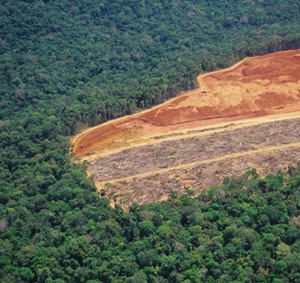
Deforestation is the removal of large areas of forest to provide land for farming and roads, and to provide timber (wood) for building, furniture and fuel. Deforestation has a number of undesirable effects on the environment.
Picture
Deforestation: 

  • Reduction of habitats or food sources for animals, which can result in their extinction. Animal and plant diversity is reduced, and food chains are disrupted.
  • Loss of plant species and their genes which may be important for medical use or genetic engineering in the future.
  • Removal of trees means there are no roots to hold soil, which can result in soil erosion and leaching of minerals. Desertification can eventually occur.
  • Lack of roots and soil → 

    flooding 
    and mudslides. Lakes can become silted up.
  • Leaching of nutrients into lakes and rivers →  eutrophication.
  • Less CO2 is absorbed from the atmosphere, more CO2 build up →  increase the greenhouse effect.
  • Less O2 is produced →  atmospheric O2 level can drop.
  • Less transpiration →  reduced rainfall. 

Try this

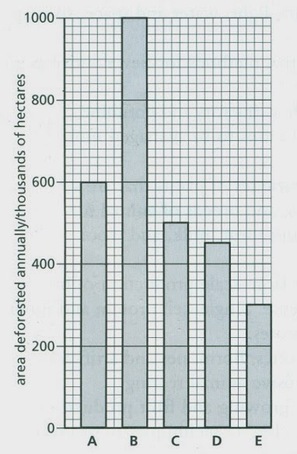
Figure below show the area of tropical rainforest deforested annually in five different countries, labeled A to E.
Picture
1. i) Which of the countries shown has the largest area deforested annually?                       [1 mark]
   ii) Which of the countries shown has 600 000 hectares of rainforest removed each year?  [1 mark]
  iii) In another country, F, 550 000 hectares are deforested annually. Plot this on a copy of the figure.                                                                                                                                               [1 mark]

2. i) Country E has a total of 9 000 000 hectares of tropical rainforest remaining. How long will it be before it is all destroyed, if the present rate of deforestation continues?                             [1 mark]

  ii) Stat 2 reasons why tropical rainforests are being destroyed by humans.                      [2 marks]
  iii) After deforestation has taken place, soil erosion often occurs rapidly. Suggest 2 ways in which this may occur.                                                                                                                      [2 marks]

3. Tropical rainforests reduce the amount of CO2 and increase the amount of O2 in the atmosphere. Explain why both these occurrences are important to living organisms.                            [ 2 marks] 

Answer

1. i) B
   ii) A
    iii) Column for F drawn to 550. Column shaded in the same way as the others, and labeled. Column drawn an equal width and distance from the others.
2. i) 30 years
   ii) 2 reasons from:
  • to clear land for agriculture, housing, industry or roads.
  • to collect timber for housing
  • to collect timber for fuel.
 iii) 2 suggestions from:
  • plants have gone so there are no roots to bind the soil.
  • wind blows soil away
  • rain washes soil away.
3. Increased CO2 can lead to global warming, or flooding, or desertification.
O2: organisms need O2 for respiration to release energy. 

This post on blogspot.com

Print Friendly and PDF
comments powered by Disqus
Powered by Create your own unique website with customizable templates.
